
Over a decade of experience helping student earn a 5 in AP Art
A working studio in Cupertino where students make art alongside each other up to four days a week, and one-to-one coaching over video that sets each student's direction. Take either. Most of our strongest students take both.

Register for a Tryout AP Studio Art & College Portfolio Class Today!
Use this form ONLY for AP Studio Art & College Portfolio Class in the Spring and Fall Semester. If you’re looking for Core Art, Clay Art, and Digital Art tryout classes, please visit hongyunart.com/tryout
One-time tryout classes are required to assess a student's readiness for our program. We will also assess your student's level to ensure they are placed in the proper class for them.
Please keep in mind that acceptance to Hongyun Art is not guaranteed and that there are no refunds for tryout classes.
AP Studio Art & College Portfolio
Our AP Studio Art & College Portfolio classes are highly structured classes designed to help students achieve score of 4 or 5 on the AP and produce a top level portfolio suitable for supplemental submission on college applications for non-art and art majors.
We offer classes for AP Drawing and AP 2D Art and Design and College Portfolio help.
Weekly class sessions are offered during the school year only (August - June). In the summer, we offer 1/2 day or full day portfolio camps
Outside of their regular class time, students enrolled in this class receive unlimited studio time to work on their projects with teachers ready to help answer questions.
AP Studio Art & College Portfolio FAQ
-
AP Art is different from most AP subjects. Instead of taking a traditional written exam, students develop and submit an art portfolio to College Board. Students are evaluated on much more than finished artwork. Their portfolio demonstrates ideas, technical skills, experimentation, development, revision, and creative thinking.
-
Yes, very much so! This is a common misconception - AP Art is actually for students who plan to go to college for non-art majors. This is very common in our program. Many students use art as an important enrichment activity while planning to pursue engineering, science, medicine, business, technology, humanities, or other fields. Serious art study develops and demonstrates creativity, independent thinking, problem-solving, commitment, and personal voice. We do not believe AP Art is only for future professional artists.
-
Yes! Top colleges allow optional arts supplement or portfolio, including students applying for non-art majors. Every university has different requirements, so families should check each college's current admissions policy. Our philosophy is simple: build strong work first. When an appropriate opportunity exists, the student has something meaningful to show.
-
For AP Drawing and AP 2-D Art & Design, the portfolio contains two major components. Sustained Investigation (60%): students submit 15 images showing the development of an artistic inquiry through practice, experimentation, and revision, together with written evidence. Selected Works (40%): students submit 5 of their strongest works demonstrating their skills, ideas, materials, and processes.
The Hongyun Art App helps students track and organize their work.
-
AP Drawing emphasizes drawing skills such as line, mark-making, value, form, surface, space, and composition. AP 2-D Art & Design has a broader two-dimensional design focus and may include painting, photography, digital art, illustration, collage, graphic design, and mixed media. We help students determine which direction best matches their strengths, interests, and body of work.
-
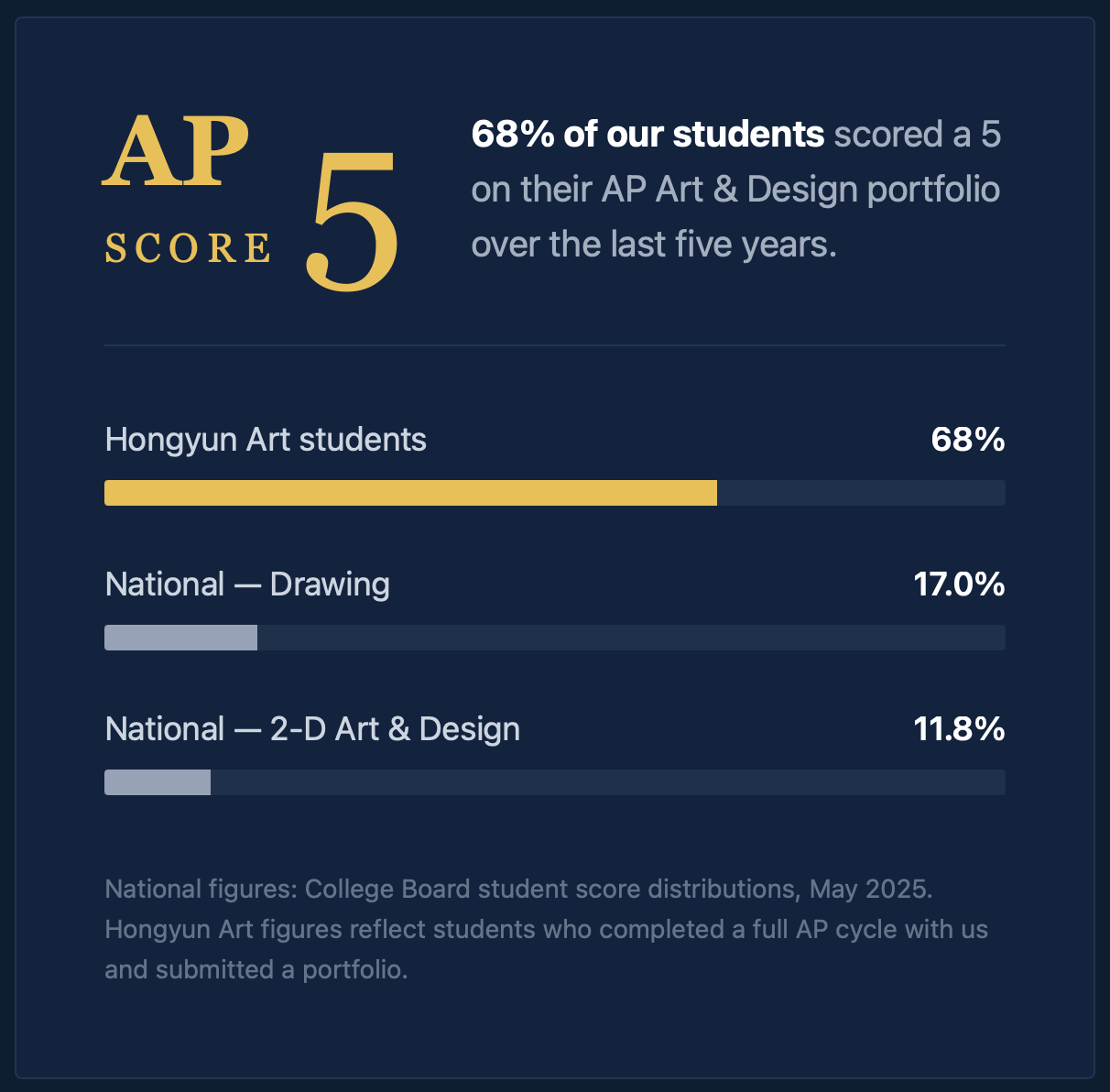
Historically, approximately 60–70% of our AP students have earned a 5, the highest possible AP score, with additional students earning a 4. The national average is about 11-12% of students receiving a score of 5.
Our school serves approximately 1,000 students every week, including about 120 students participating weekly in our AP Art & Portfolio Program. We have more than 10 years of experience preparing students for AP portfolios.
-
College Board does not require formal prerequisites for AP Art & Design. However, our philosophy is to build the foundation before building the portfolio. Students benefit from strong fundamentals in drawing, proportion, perspective, composition, value, color, different media, and visual problem-solving. Strong technical skills give students greater freedom to communicate sophisticated and original ideas.
Most students switch to AP Art when they are in Yellow Cloud and Orange Cloud
-
We allow 8th grade students to join the AP Program and start diversifying their skill set to more advanced techniques to build their portfolio.
Middle school is an excellent time to develop technical skills, creativity, exploration, independent thinking, and personal voice. Instead of pushing younger students to produce “AP-looking” artwork, we focus on developing the skills and thinking ability that will make advanced portfolio work possible later.
-
Motivated students who are confident and ready for a greater challenge may begin our AP Art & Portfolio pathway as early as 8th grade.
Students beginning in 8th grade generally aim for AP portfolio completion by 10th grade.
Students beginning in 9th grade generally aim for completion by 11th grade.
Students beginning in 10th grade receive an individual plan based on readiness.
Students joining at the beginning of their 11th grade year have a very tight timeline and need to attend class multiple times a week especially during Spring Crunch (Feb-end of April).
NOTE: These are target timelines—not guarantees.
Technical ability, creative maturity, work ethic, attendance, academic workload, and individual circumstances can affect the timeline.
Starting early is not about rushing; it gives students more time to build fundamentals, explore, develop ideas, revise, and build a strong portfolio.
-
Yes.
This is one of the major benefits of our program. Students enroll in one regular weekly AP/Portfolio class, approximately 2 hours and 45 minutes long, but they are not limited to working only during that scheduled class.
AP/Portfolio students may return to work on their portfolios during our school operating hours Thursday through Sunday. We know our students have busy schedules so we make this as flexible as possible -there’s no need to pre-schedule, just drop in, pull your artwork from your cubby, and get to work! The studio is there for you whenever you’re able to come in.
This extended studio access gives motivated students more time to finish, practice, experiment, revise, improve, and work ahead.
Additional studio access is subject to normal operating hours, available workspace, supervision, and school scheduling.
-
Because serious portfolios require serious time. Achieving the highest AP score at 5x the rate of the national average requires a little more than the average student. Hongyun Art teachers have developed techniques and shortcuts to help students along but students still need to put in the “elbow grease” to make the work.
Some students work quickly; others may spend many additional hours developing and refining a single piece. We do not want a motivated student to stop simply because a scheduled class has ended. Students willing to put in more effort should have the opportunity to push their work further.
-
A truly strong AP portfolio cannot be created at the last minute.
Students need time to investigate, experiment, make mistakes, revise, develop, and refine.
Good time management and consistent work habits are especially important for high-school students balancing academics, extracurricular activities, and other AP courses.
-
A 5 is an excellent achievement, and we are proud of our students' AP results.
But a score is not our only goal. We want students to learn how to develop an idea, experiment, solve problems, accept feedback, revise, improve, and finish strong.
Those abilities remain valuable whether a student eventually studies art, engineering, medicine, business, technology, or another field.
-
We do not believe great portfolios come from teaching students to simply copy beautiful pictures - an actually AP Art graders confirm this. Students who simply copy from reference do not score well in AP Art.
Our approach is: Foundation → Creativity → Independent Thinking → Personal Direction → Craftsmanship → Portfolio.
For future artists and designers, this creates a strong technical and conceptual foundation for advanced study.
For students pursuing other fields, art provides an opportunity to demonstrate how they think, create, solve problems, persist, and develop original ideas.